
Parkinson’s disease is a movement disorder brought on by damage to neurons, or nerve cells, in the brain. Neurons are responsible for the exchange of information between your brain and body.
For example, when you write out a grocery list, neurons send instructions to the muscles in your hand on how to grip the pencil. Or when you eat a piece of cake, smell receptors and tastebuds send a message to the neurons to let your brain know that the cake is stale and there was clearly a mix-up between sugar and salt during the baking process.
With Parkinson’s disease, neurons weaken, become damaged, and die. This can happen because of genetics, or environmental factors, or because of growing old — close on the heels of Alzheimer’s, Parkinson’s disease is the second most common neurodegenerative illness affecting senior adults aged 65 years and above.
According to one study, 90,000 people are diagnosed with Parkinson’s disease each year and the disorder affects men 1.5 times more than women.
What does hypo mean
As with plenty of medical terms, ‘hypo’ has its origins in ancient Greek. It comes from the Greek word ‘hupo’, which means under, below, or less than normal.
Hypo is usually prefixed to words to show less than ideal conditions, for example,
- hypoglycemia, or blood sugar that is too low
- hypothyroidism, when the thyroid gland isn’t working at full capacity
- hypotension, when the force of blood pushing against artery walls is too weak
and so on.
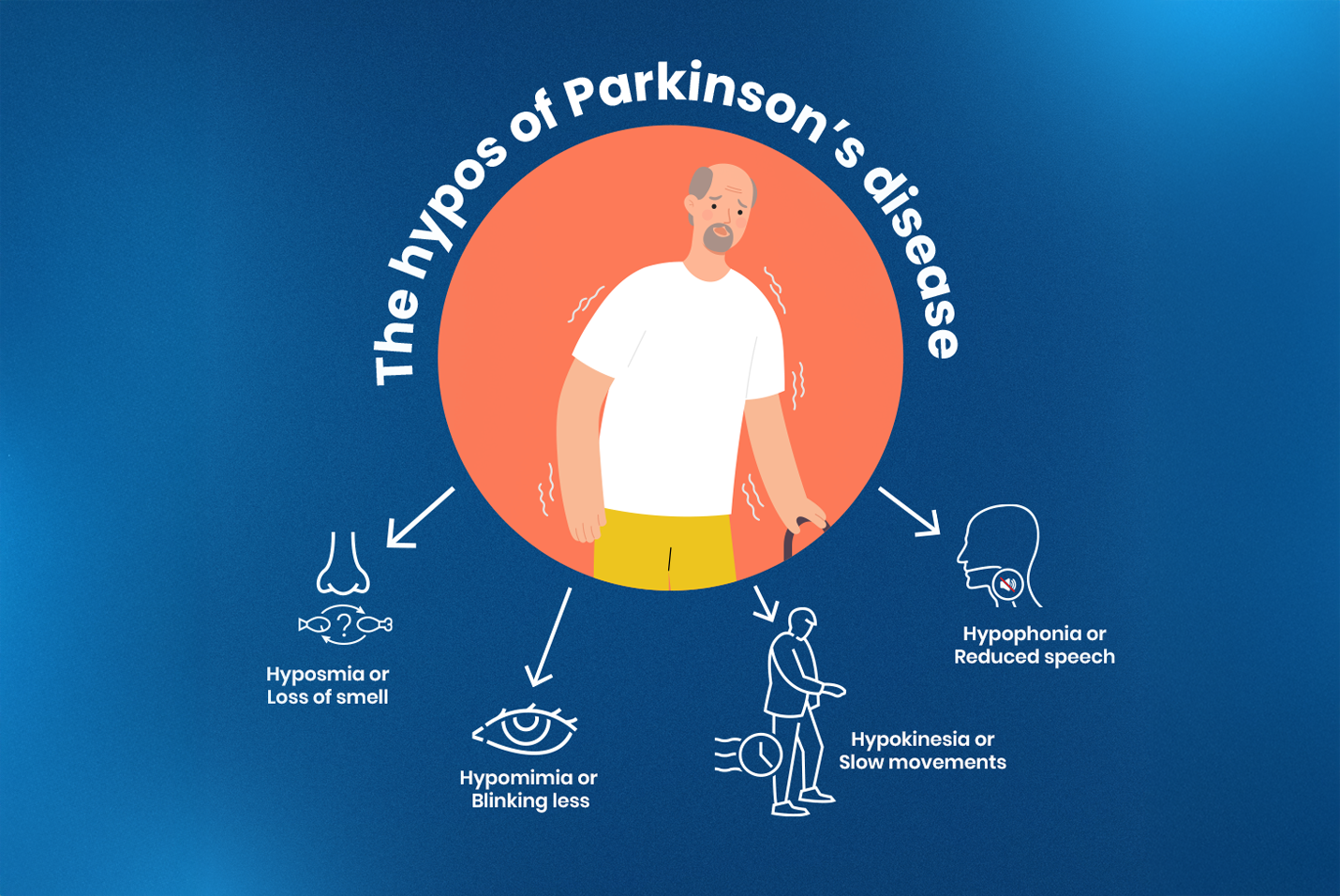
The hypos of Parkinson’s disease
Think of a time when your car, or washing machine, or lawn mower decided to stop working. Often when a machine is about to conk out, it warns you by first slowing down. Gears grind, it stalls, the wheels struggle to turn, and if there are any lights, they fade and grow dim.
A similar thing happens with Parkinson’s disease: it makes your body slow down. Senses grow dull, movements become difficult, and it is harder to send out signals of emotion.
‘Hypos’ are often some of the first signs of Parkinson’s disease. The more prevalent hypos are:
Hypophonia
‘Phonia’ comes from the Greek word ‘phone’, which means sound. Hypophonia is characterized by a soft, breathy, and weak sounding voice. It is an early symptom of Parkinson’s disease, affecting almost 9 out of 10 patients.
A person with hypophonia struggles to speak loud enough for others to hear. This happens because damaged neurons in the brain cannot effectively control either the laryngeal muscles in the throat and chest, or those in the diaphragm that control airflow and consequently, how loud you can talk.
Additionally, muscles in the chest may stiffen and atrophy over time, preventing the lungs from expanding fully to give your voice any volume.
Hypophonia can be distressing for patients. Other people may repeatedly ask them to speak louder, but since they simply cannot increase their volume, they may choose to withdraw and become socially isolated.
- Hypokinetic dysarthria
Hypokinetic dysarthria is having trouble speaking coherently. Persons with Parkinson’s disease cannot control the movement of their lips, tongue, and jaw to shape words, so their speech comes out unclear, distorted, and slurred.
Hypokinetic dysarthria also affects pitch and tone. These are inflections in speech that help us convey emotion, kind of like verbal punctuation. Recognizing pitch and tone is what allows us to differentiate between “Yes! We won!” and “Yes, I broke the lamp.”
It requires quite a lot of coordination between neurons in the brain and several muscles in the body to be able to create pitch and tone. People with Parkinson’s disease have a hard time doing that, so they end up speaking in a wooden monotone. They literally, physically, cannot express emotion even if they wanted to.
- Hyposmia
Hyposmia is a combination of the words hypo and ‘osme’, which is Greek for smell. A non-motor symptom of Parkinson’s disease, hyposmia is a marked reduction or loss in your ability to smell and identify odors.
As with hypophonia, hyposmia is one of the earliest signs of Parkinson’s disease. It can happen suddenly, or gradually. In fact, hyposmia may occur several years, even decades before the neurological disorder itself has progressed far enough to be diagnosed.
Losing the ability to smell is a severe health and safety hazard as people with hyposmia may not be able to detect gas leaks or a fire.
They may also not be able to taste food, as any flavors we identify with our tongue are heavily supported by scent particles that enter our nostrils, and those that travel up the back of the throat to the nasal passages when food is chewed.
Faced with tasteless food, a person may decline to eat, which can lead to malnutrition. Or, they may start to season heavily with salt and put their kidneys at risk.
Also, since they can’t taste if anything is wrong, senior adults with Parkinson’s disease are at risk of accidentally eating foods that are spoiled, contaminated, or toxic. This may send them to the hospital with severe complications such as vomiting, diarrhea, and dehydration. In people with weak immune systems, food poisoning can be fatal.
- Hypokinesia
Originating from the Greek word ‘kinetikos’, kinesia refers to the ability to move. One of the biggest signs of Parkinson’s disease is a person’s loss of control over their movements.
It is well-known that people with Parkinson’s disease have an involuntary shake or tremor, but losing control over movements also means you can’t move as much, or as expansively, as you would like to.
Hypokinesia is identified by slow, small, limited movements as well as difficulty in initiating movement. Shuffling along with tiny, cramped steps instead of taking long, open strides, using smaller or fewer hand gestures when talking, and struggling to rise from a chair are all examples of Parkinson’s disease-induced hypokinesia.
- Hypomimia
‘Mimia’ comes from the Greek word ‘mimos’, which means to imitate, or act as something. Also known as masked face and facial masking, hypomimia is a gradual loss of movement in the face.
The average person blinks their eyes at the rate of 15-20 times per minute. According to one study, people with hypomimia brought on by Parkinson’s disease blink at a much slower rate of 11-16 times per minute.
Hypomimia also makes it difficult to smile and to frown, raise your eyebrows, and show concern or any other emotion through facial expression only. Some people can’t close their mouths, which causes drooling.
What to do if you notice a hypo
Should you notice anything unusual about your sense of smell and taste, if you’ve been struggling to speak, or if someone has pointed out your manner of walking is not the same as before, do not dismiss it.
Schedule an appointment with your doctor immediately because, as with almost every health condition, the earlier your condition is diagnosed, the sooner you can take steps to stay healthy.
Parkinson’s disease is a progressive disorder, meaning that it gets worse with time. It is not curable and there is no guaranteed way to prevent it from developing, but it is very much manageable.
At present, most treatments for Parkinson’s disease focus on managing symptoms with the help of medications, physical therapy, and in some cases surgery. With the right combination of these, you may be able to live a normal, independent life for many years.